 Member of Morris Group International
Our All-in-One Dialysis Box System Is Designed for Infection Prevention.
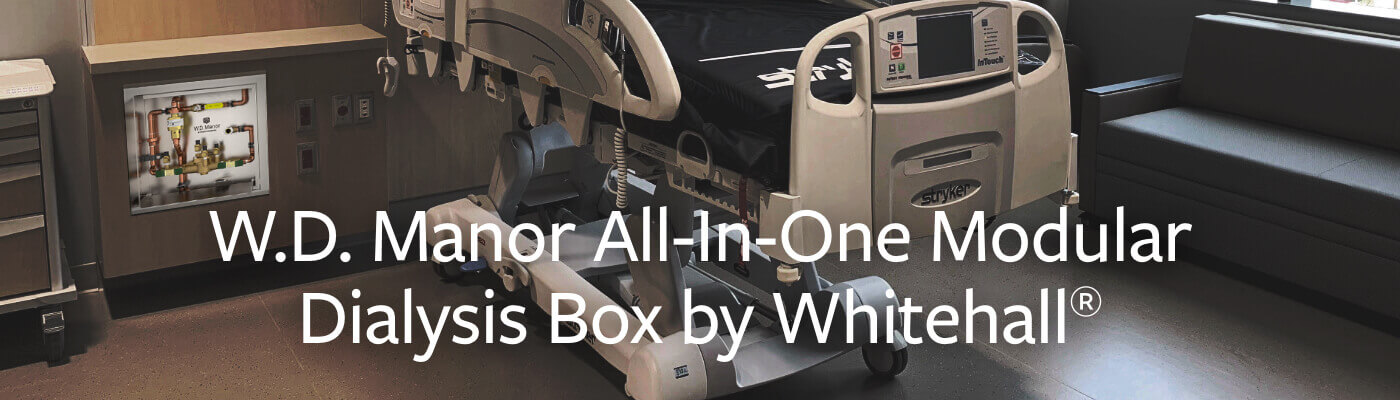
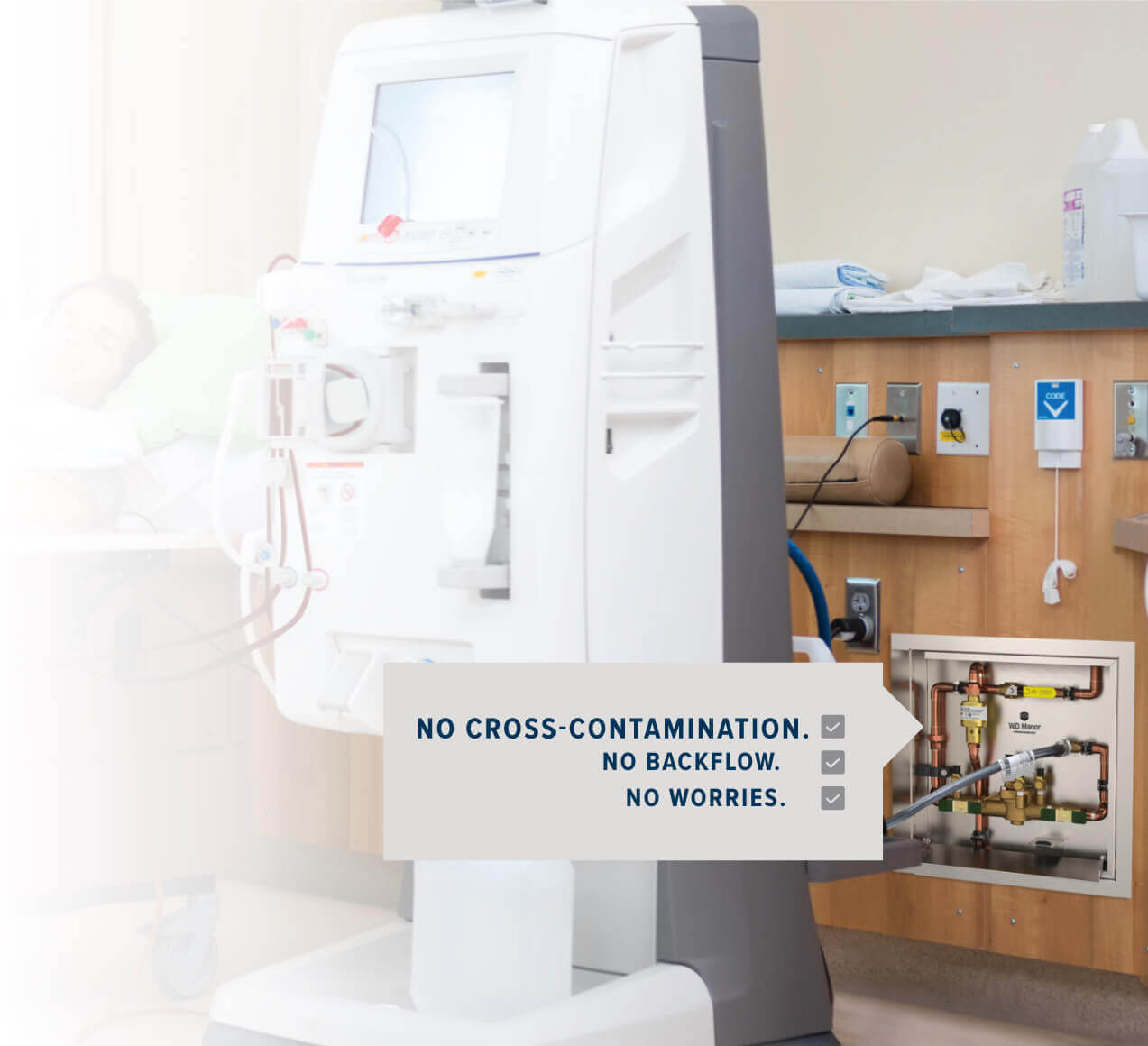
The W.D. Manor All-In-One Modular Dialysis Box by Whitehall® protects patients at their most vulnerable, minimizes liability, and promotes significant job savings for the installer and benefits for the engineer. Each dialysis box includes an integrated reduced pressure backflow preventer. This eliminates the need to pipe back to a shared backflow preventer, and eliminates the possibility of cross-contamination that can arise from that arrangement.
Major Job Savings. Every Step of the Way
Our self-contained dialysis box can reduce labor hours for installation by up to 64%, as well as reducing material cost, in comparison to a traditional system.
Installing this prefabricated, modular system is easy to learn and repeat, and:
- Arrives pre-plumbed for speedy connections
- Consolidates all the required elements into one convenient, attractive, recessed, self-contained, stainless steel box
- Eliminates need for designated room to house the backflow preventer
- Eliminates excess piping requirements
- Minimizes connections and opportunities for error in plumbing system
Faster, Easier Specifications
W.D. Manor Dialysis Boxes also have benefits for engineers. With the pre-plumbed box, less work is needed for the specification.
The engineer will also find it easy to meet the varied needs of different applications due to our many available customization options.
Customization
We can customize your dialysis box system to reflect the needs of your facility.
Common customization options include:
- Back inlet for water entry instead of top inlet
- Can be supplied less door
- Quick disconnect supply fitting for dialysis machine
- Custom sizing and specifications
Dialysis Box Features
- Isolates systems on a patient-by-patient basis
- Eliminates the possibility of backflow and prevents cross contamination
- Safely use any potable water source for dialysis
- Water is temperature-controlled for safety and to adjust for seasonal variations based on the dialysis machine's optimal requirements for water temperature
Applications
Usually used for Dialysis Boxes:
- ICU/MOSU
- Isolation Rooms
- Emergency Departments
- Trauma Rooms
- Med/Surge
- Dialysis Units
- Infusion Bays
- EVS Rooms near Operating rooms – Used for cleaning machines
Other Healthcare non-Dialysis use:
- Stryker Neptune Docking Stations
- Sterilizer Hook-ups
- Lab Spaces – Usually when a piece of equipment requires a backflow and soft water
- Birthing Tubs– In labor and delivery rooms to evacuate water and waste
Other non-Heathcare uses:
- Icemaker Hook-ups
- Installed in bars and used with the ice machines/soda fountains
Get a closer look!
Download the Dialysis Box Brochure today.

Protect the patient!
Read how a modular system works.
Case Study Of A 22-Patient Bed Floor
Comparison Of Modular System Vs. Traditional System
In a modular system, backflow preventers are installed on a per-room basis
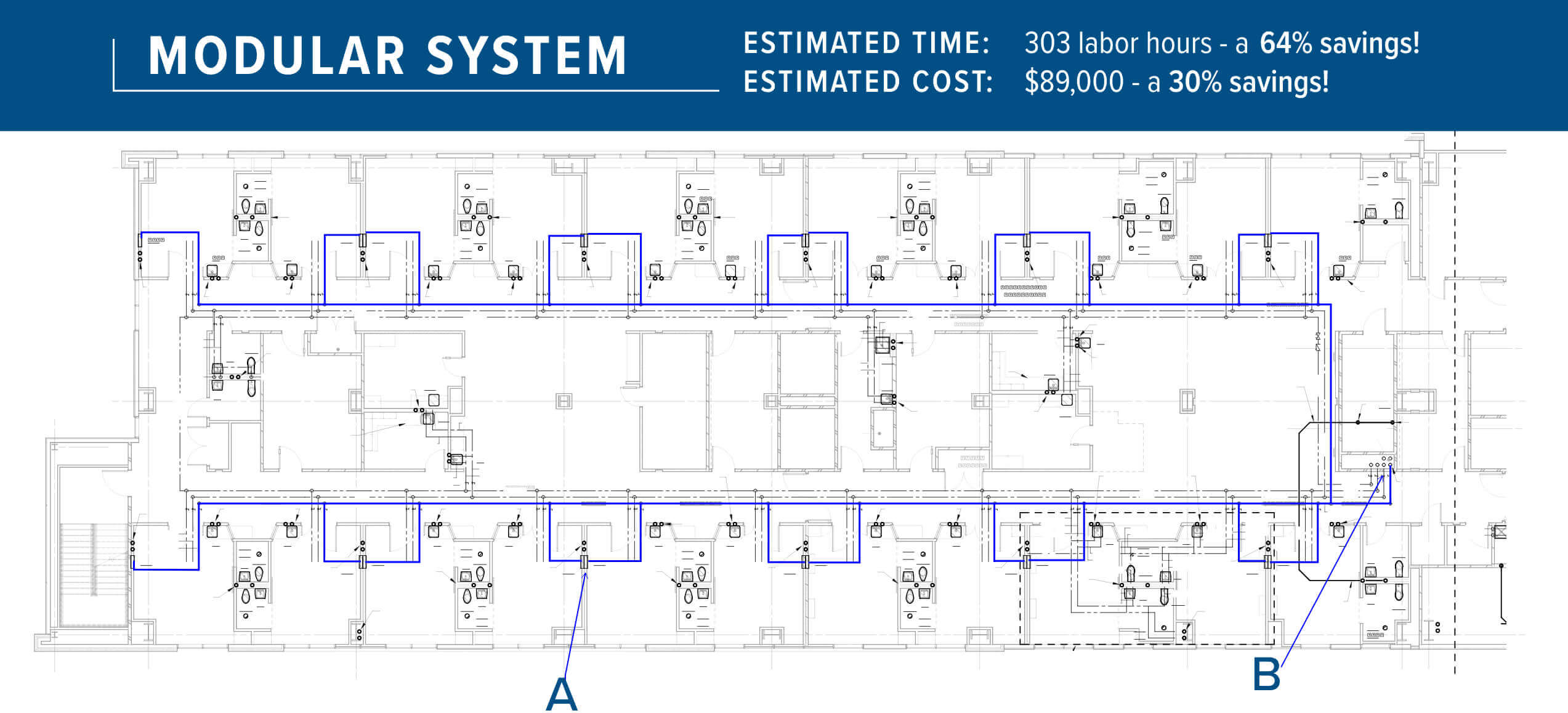
- W.D. Manor dialysis box by Whitehall installed in wall. Domestic, soft, cold potable water serving the modular dialysis box system.
- Soft, cold water exits shaft; it does not need backflow prevention.
- The integrated backflow preventer prevents contamination spreading at point of use
- Patients are not linked to each other through water supply
- The facility's water supply is protected
- Substantially reduces plumbing hanger labor & material requirements
- Minimizes spatial needs & BIM coordination for distribution piping in cramped ceilings
- A 22-patient bed floor has an estimated cost of just over $80,000—a cost savings of more than 30% as compared to a traditional system
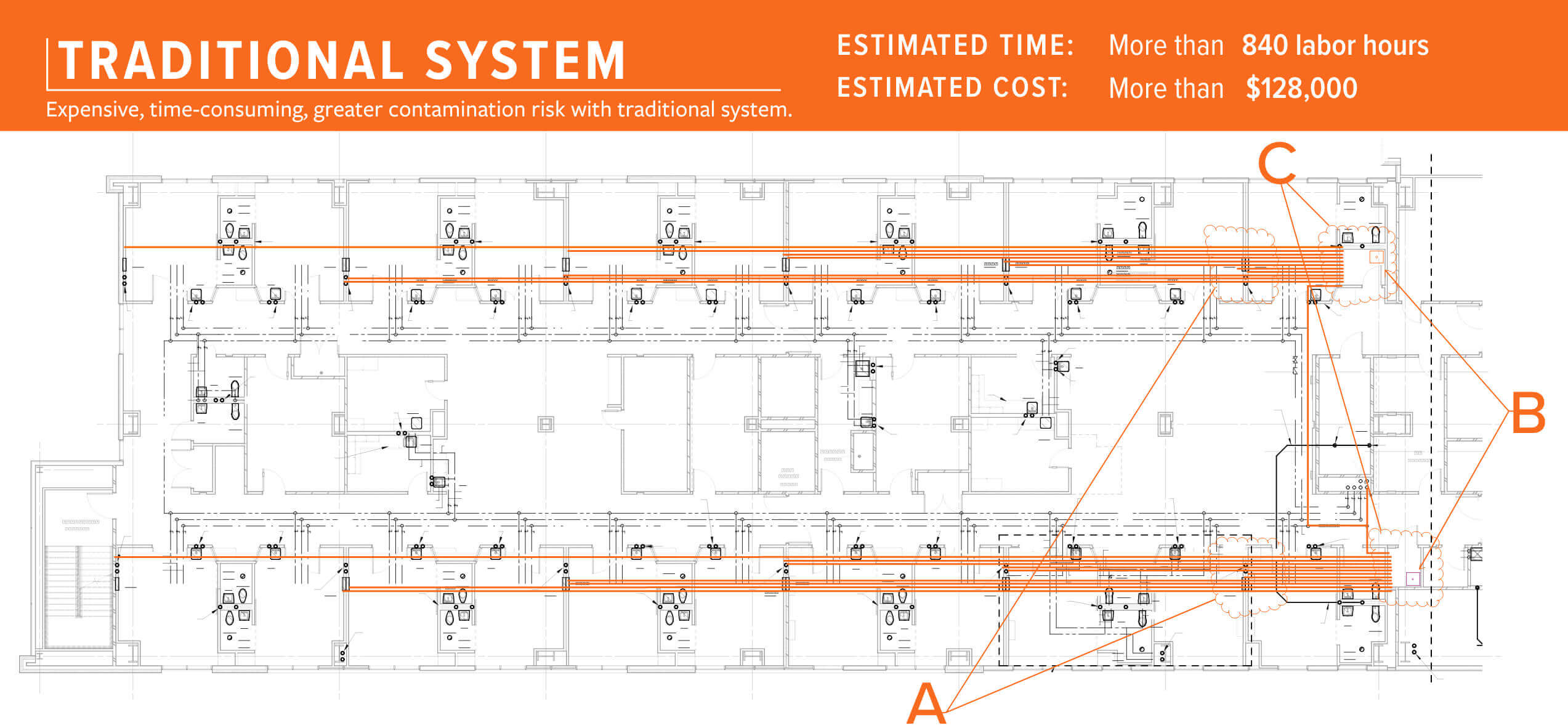
- (11) 1/2” Copper non-potable soft cold water TYP 2
- Added mop sink associated with reduced pressure backflow preventer indirect waste TYP (2)
- Backflow preventer closet (11) 1/2” reduced pressure backflow preventer TYP (2)
- Remote location for backflow preventers
- Long dead-legs of water piping prior to backflow device in the event of back pressure
- Potential for bacteria growth in stagnant water lines
- A 22-patient bed floor can cost more than $128,000 because of all the piping work
Prevent Cross-Contamination Events
Some local codes only require a single backflow prevention device for multiple water outlets, protecting the building but not the patients in the event of cross contamination
Dialysis Box with Backflow Preventer and Trap Primer Features
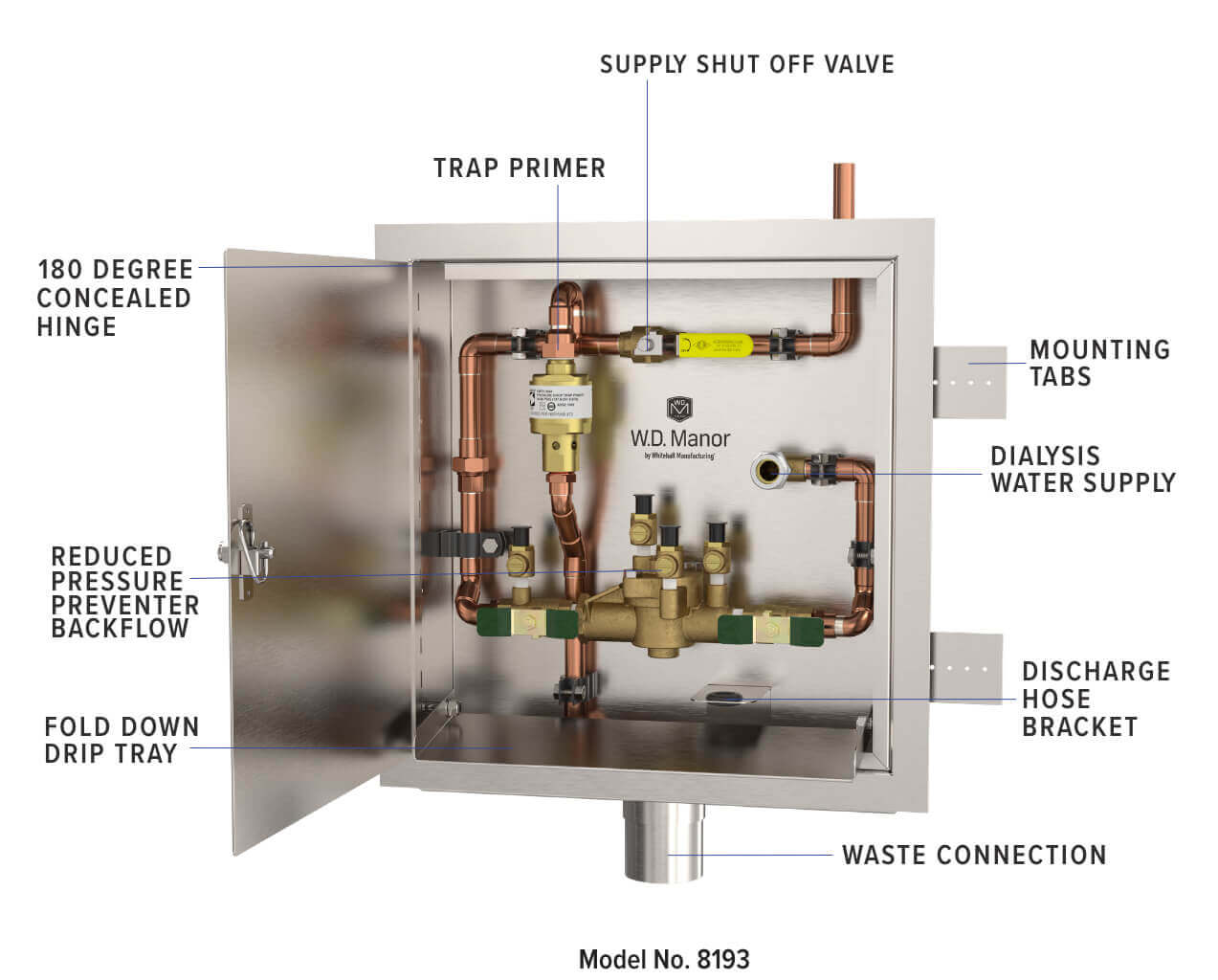
- Supply Shut Off Valve:
- Valve typically open, only closed for service of trap primer or backflow device
- Trap Primer:
- Drips water into the drain when the device senses pressure fluctuation. This keeps the P-trap wet to maintain the seal and eliminate sewer gas.
- Backflow Prevention:
- Protects the “house system” upstream from any back siphon, back flow contamination event.
- Fold Down Drip Tray:
- Manually fold down tray to catch any spillage from the supply or discharge hoses from running down cabinet and wall.
- Dialysis Supply:
- Potable water supply via male hose thread adapter
- Waste Connection:
- 2” IPS Drain
- Patent No. 8834718
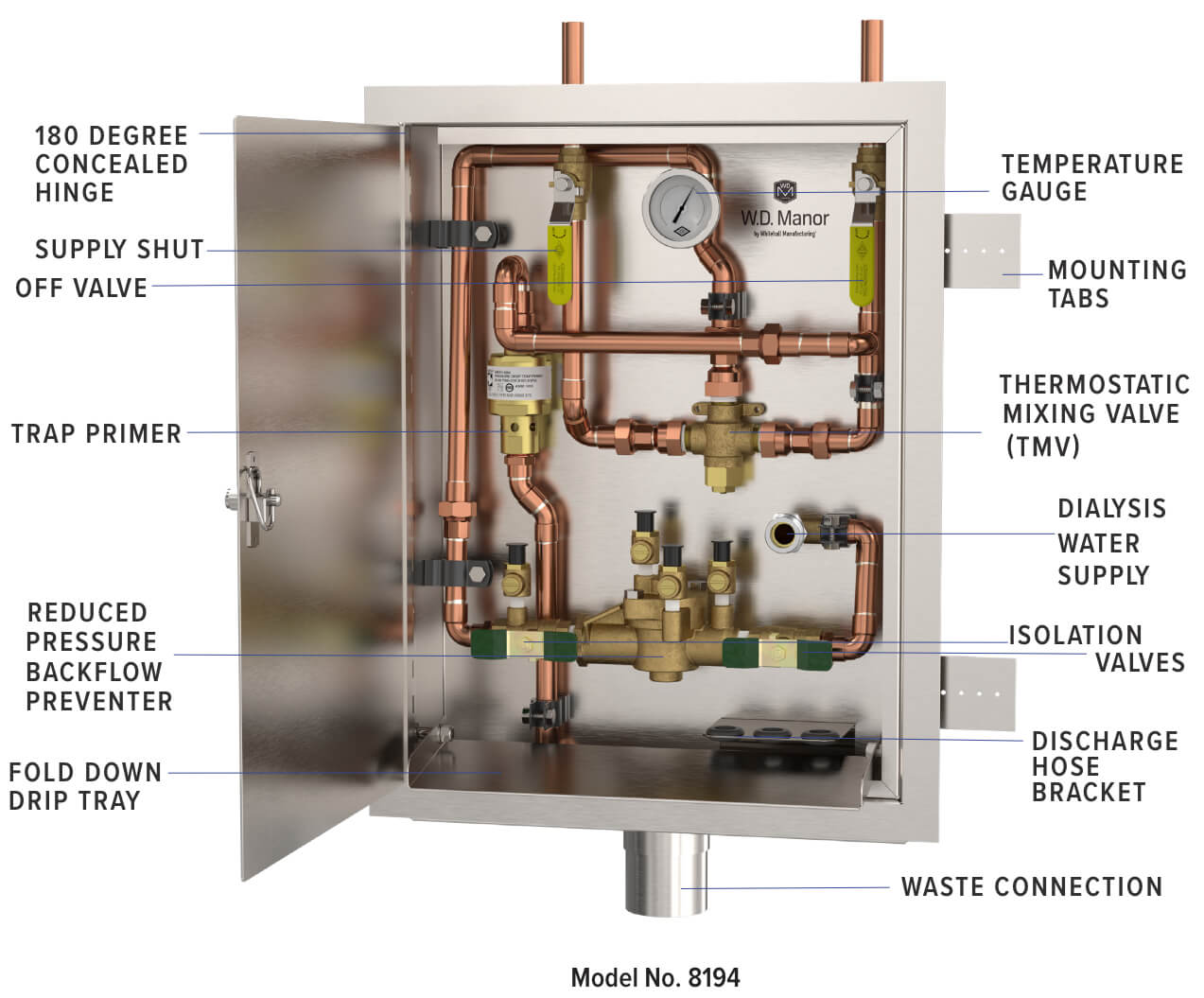
Dialysis Box with Backflow Preventer, Trap Primer, and Thermostatic Mixing Valve
- Supply Shut Off Valve:
- Valve typically open, only closed for service of trap primer or backflow device.
- Trap Primer:
- Drips water into drain when the device senses pressure fluctuation. This keeps the P-trap wet to maintain the seal and eliminate sewer gas.
- Backflow Prevention:
- Protects the “house system” upstream from any back siphon, back flow contamination event.
- Fold Down Drip Tray:
- Manually fold down tray to catch any spillage from the supply or discharge hose from running down cabinet and wall.
- Dialysis Supply:
- Potable water supply via male hose thread adapter.
- Waste Connection:
- 2” IPS Drain
- Thermostatic Mixing Valve (TMV):
- Used to temper the hot and cold water to optimal temperature. Most dialysis machines require between 75-78° F water.
- Temperature Gauge:
- Reads the current temperature of the dialysis supply water.
- Patent No. 9724457
Request More Information

Dialysis Box Plumbing
Download Article

Why it Works
Download Article

Protecting the Patient
Download Article